USDT vs USDC: The Stablecoin Showdown That Could Protect (or Cost) You in 2026

Two dollars. Same peg. Wildly different risks.
You trust a stablecoin to hold its value. But not every "stable" coin is built the same way. One has faced hundreds of millions in regulatory fines. The other briefly lost its peg in 2023 when its banking partner collapsed. Now a landmark U.S. law has changed the rules for both — permanently.
Choosing the wrong stablecoin for your strategy is not just inconvenient. It can cost you real money or real access. This guide breaks down every meaningful difference between USDT (Tether) and USDC (USD Coin) as of 2026, so you can make an informed choice — not a guess.
Key Takeaways
- USDT is the world's most traded stablecoin by volume but has been delisted on EU-regulated exchanges and faces significant new obligations under U.S. law.
- USDC is more transparent, U.S.-regulation-friendly, and now issued by a publicly traded company (NYSE: CRCL), but carries censorship and centralization risk.
- Both maintain a 1:1 USD peg, but their reserve compositions and regulatory trajectories differ significantly.
- The GENIUS Act, signed into law on July 18, 2025, has reshaped the competitive dynamic between the two — and that impact is still unfolding.
- Your choice should depend on your trading platform, jurisdiction, and risk tolerance.
What Is the Difference Between USDT and USDC? Here Is the Honest Answer
USDT (Tether) and USDC (USD Coin) are both fiat-backed stablecoins pegged to the U.S. dollar, but they differ in issuer, reserve composition, regulatory standing, transparency, and — increasingly — availability by geography.
Who Issues Each Coin?
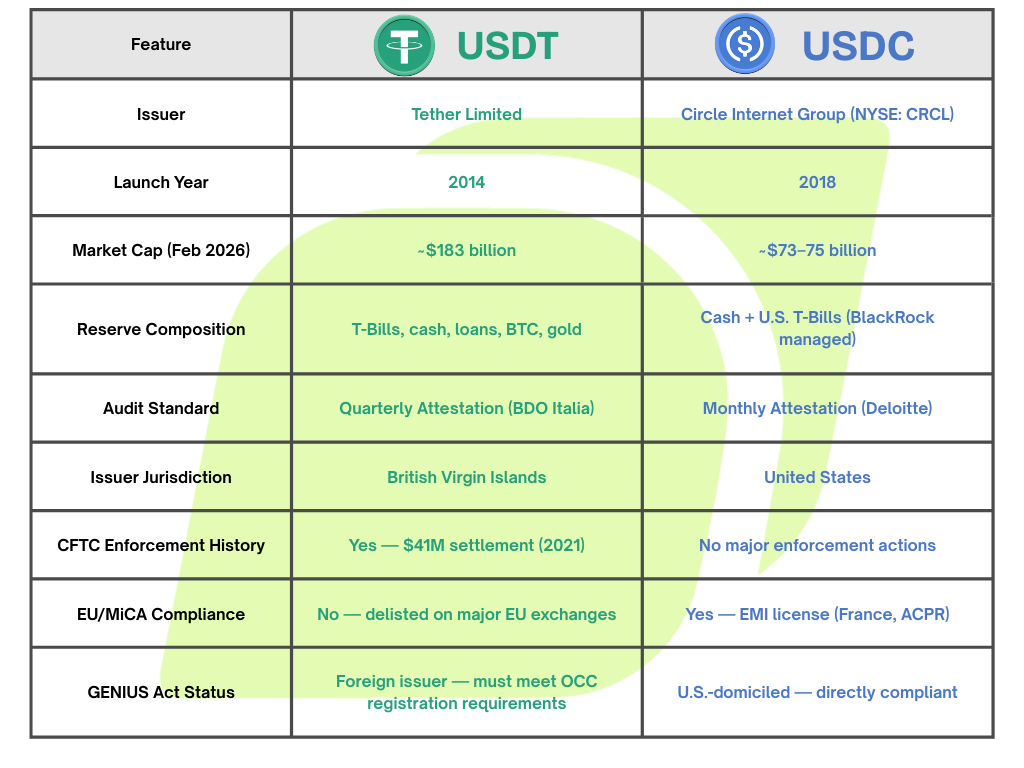
USDT is issued by Tether Limited, a company incorporated in the British Virgin Islands and operationally based in Hong Kong. Tether Limited is a subsidiary of iFinex Inc., the same parent company that operates the Bitfinex exchange.
USDC is issued by Circle Internet Financial, now formally known as Circle Internet Group, Inc., a U.S.-based fintech company that went public on the New York Stock Exchange under the ticker CRCL on June 5, 2025. Circle holds a BitLicense from the New York State Department of Financial Services (NYDFS) and operates under U.S. money transmission regulations in 46 states.
Note: USDC was co-launched in 2018 through the Centre Consortium, a joint venture with Coinbase. That consortium was formally dissolved in August 2023. Since then, Circle has been the sole governance authority over USDC.
How Each Stablecoin Is Backed?
Both coins claim a 1:1 USD backing. But "backed by dollars" is not always the full picture.
According to Tether's most recent reserve disclosures, over 80% of USDT reserves are held in U.S. Treasury Bills, with the remainder spread across cash, money market funds, secured loans, Bitcoin (82,000+ BTC as of early 2025), and precious metals (48 metric tons of gold). Tether produces quarterly attestations through BDO Italia, but these are attestations — not full independent audits. As of March 2025, Tether CEO Paolo Ardoino announced the company was actively working to engage a Big Four accounting firm to conduct a full audit, acknowledging the long-standing gap in transparency.
Circle publishes monthly attestation reports verified by Deloitte. USDC reserves consist of cash held at regulated U.S. financial institutions and short-dated U.S. Treasury securities managed through a dedicated fund run by BlackRock. This is a meaningfully narrower and more conservative reserve structure than Tether's.
At-a-Glance Comparison
Is USDT or USDC Safer? The Risk Profile You Need to Know
Neither USDT nor USDC is risk-free, but their risks are categorically different. USDT carries greater regulatory and reserve opacity risk. USDC carries greater censorship and centralization risk.
USDT's Regulatory History
The record matters. In October 2021, the U.S. Commodity Futures Trading Commission (CFTC) fined Tether Limited $41 million for making untrue or misleading statements about USDT's backing. For a period between 2016 and 2019, Tether did not maintain full dollar reserves backing its tokens at all times.
The New York Attorney General reached a separate settlement with Tether and Bitfinex in February 2021, requiring Tether to pay $18.5 million and submit to ongoing transparency reporting requirements.
These are not rumors. These are settled regulatory facts with a public paper trail. Any risk assessment of USDT must include this history.
According to a 2024 report by JPMorgan, while USDT's market dominance has solidified over the past two years, Tether's "lack of regulatory compliance and transparency" poses an increasing risk to market stability. That report preceded both the GENIUS Act and Tether's Big Four audit announcement — but the underlying concern about reserve opacity remains valid.
USDC's Censorship and Peg Risk
USDC carries its own category of risk: compliance-driven centralization. Circle has confirmed it can and does freeze USDC wallets at the request of law enforcement. In August 2022, following U.S. Treasury sanctions on the Tornado Cash protocol, Circle froze over $75,000 worth of USDC addresses associated with the sanctioned contracts.
USDC also briefly lost its peg in March 2023 when news broke that Circle held approximately $3.3 billion in reserves at Silicon Valley Bank (SVB) at the time of its collapse. USDC traded as low as $0.87 on some exchanges before Circle confirmed the funds were secured and the peg recovered fully within 72 hours.
For users who prioritize permissionless finance, USDC's compliance infrastructure is a meaningful constraint.
Which Is Safer for Different User Types?
For traders on centralized exchanges who prioritize liquidity and market depth, USDT's sheer volume remains unmatched. For DeFi users, businesses, or those in U.S.-regulated environments who need a transparent, audited, institutionally trusted product, USDC is the stronger choice by most objective criteria — and the Circle IPO in June 2025 added a new layer of accountability through public markets disclosure requirements.
Which Stablecoin Has More Liquidity? Volume Tells the Story
USDT has significantly more trading liquidity than USDC globally, making it the dominant stablecoin for spot and derivatives trading on most centralized exchanges.
Market Capitalization in 2026
As of early 2026, USDT holds a market capitalization of approximately $183 billion, making it the third-largest cryptocurrency by market cap overall. USDC holds approximately $73–75 billion — a remarkable reversal from its post-SVB trough and Binance deconversion in 2022. According to Stock Analysis data citing Circle's own disclosures, USDC circulation surged 108% year-over-year through mid-2025, driven by institutional demand, GENIUS Act clarity, and the Circle IPO.
For context, the Brookings Institution reported in October 2025 that U.S. dollar-backed stablecoins overall reached more than $260 billion in total circulation by Q3 2025, with monthly on-chain transaction volumes exceeding $1 trillion — approximately ten times the volume recorded at the end of 2020.
Exchange Availability and Pairs
USDT trading pairs exist on virtually every centralized exchange globally, including Bitunix, OKX, Bybit, and HTX. USDC has deeper integration on U.S.-focused platforms like Coinbase (which co-created USDC and still earns revenue sharing from Circle) and is the stablecoin of choice for many institutional on-ramps.
For peer-to-peer and emerging market trading, USDT continues to dominate. According to the 2024 Chainalysis Geography of Cryptocurrency Report, USDT accounts for the majority of stablecoin transaction volume in Latin America, Sub-Saharan Africa, and Southeast Asia — specifically for remittances and currency hedging. In countries like Argentina and Turkey, where local currencies face chronic inflation, USDT has become a de facto digital dollar for everyday users.
DeFi Liquidity
In decentralized finance (DeFi), the picture is more balanced. USDC is deeply integrated into protocols like Compound, Aave, and Uniswap, and has historically been preferred in U.S.-accessible DeFi due to compliance considerations. USDT is used heavily on Tron-based DeFi and maintains a strong presence on BNB Chain and Solana.
Can USDT Lose Its Peg? What the Data Shows
Yes, USDT can and has briefly lost its peg under extreme market stress, though it has always recovered. The theoretical risk stems from reserve opacity and the concentration of issuer risk.
Historical De-Pegging Events
The most significant USDT de-peg occurred in May 2022 during the collapse of the Terra/LUNA ecosystem. USDT briefly traded at $0.95 on some platforms as panic selling hit all stablecoins. It recovered within 24 hours.
By contrast, TerraUSD (UST) — an algorithmic stablecoin with no real collateral backing — collapsed to near zero permanently during the same period. This distinction is critical: USDT is asset-backed, not algorithmic. A de-peg for USDT due to a bank run scenario would require a simultaneous failure of its T-Bill and cash reserves, which is a very different risk profile from UST.
The Reserve Quality Improvement
Tether has progressively improved its reserve quality since 2022. It eliminated its commercial paper exposure entirely, shifting almost entirely into U.S. Treasury Bills. As of its most recent disclosures, approximately 80%+ of reserves are in T-Bills, with the remainder in cash, gold, and other assets. However, the Brookings Institution noted in October 2025 that roughly 20% of USDT reserves still consist of assets that are not cash and cash equivalents — including secured loans, Bitcoin, and precious metals — which are less liquid under stress scenarios than T-Bills alone.
Is USDC Regulated? Understanding the Compliance Advantage in 2026
USDC is issued under U.S. money transmission regulations, holds an EU Electronic Money Institution license, and is backed by a publicly traded company subject to SEC disclosure requirements. It is one of the most compliance-forward stablecoins in existence.
Circle's Regulatory Framework
Circle Internet Financial holds money transmission licenses in 46 U.S. states, plus a BitLicense from the New York State Department of Financial Services. It is registered with FinCEN as a money services business. As a public company (NYSE: CRCL since June 5, 2025), Circle is now additionally subject to SEC quarterly and annual reporting requirements — a level of financial transparency no other major stablecoin issuer currently matches.
The Circle IPO itself was a defining moment. Shares surged 168% on day one, closing at $83.23 after pricing at $31 per share, in one of the year's strongest IPO performances. The offering raised over $1.1 billion, pushing Circle's valuation past $16 billion. The stock later peaked at $298.99 in June 2025 and has since corrected significantly — currently trading around $60–63 as of late February 2026, with a market cap of approximately $14–15 billion — but the public listing itself permanently changed Circle's accountability structure.
MiCA and the European Divide
The EU's Markets in Crypto-Assets (MiCA) regulation came into full force for stablecoin issuers on March 31, 2025. The consequences for USDT were not theoretical. They were immediate:
Coinbase Europe delisted USDT in December 2024 in anticipation of the deadline. Binance delisted USDT for users in the European Economic Area (EEA) in March 2025. Kraken moved USDT to sell-only mode for EEA users that same month.
Circle, by contrast, had already secured an Electronic Money Institution (EMI) license from the French Autorité de Contrôle Prudentiel et de Résolution (ACPR), positioning USDC as the MiCA-compliant alternative. For European users and EU-regulated platforms, USDC is now the default regulated stablecoin option.
The GENIUS Act — A New Legal Reality

The most consequential development of 2025 for the stablecoin market was the signing of the GENIUS Act (Guiding and Establishing National Innovation for U.S. Stablecoins Act). President Trump signed it into law on July 18, 2025, after it passed the Senate 68-30 on June 17 and the House 308-122 on July 17. It is the first comprehensive federal stablecoin law in U.S. history.
Key requirements under the GENIUS Act include the following. All payment stablecoin issuers must maintain 1:1 reserves in approved liquid assets (cash, short-term T-Bills, repos). Issuers must make monthly public disclosures of reserve composition. Issuers with more than $50 billion in outstanding stablecoins must submit audited annual financial statements. Foreign issuers that want to offer stablecoins to U.S. persons must be from a jurisdiction with a comparable regulatory regime, register with the OCC, and hold reserves in a U.S. financial institution sufficient to meet the liquidity demands of U.S. customers.
The act takes full effect on the earlier of January 18, 2027, or 120 days after final federal regulations are issued. Digital asset service providers have a three-year transition period — until July 2028 — to restrict their offerings to GENIUS Act-compliant stablecoins.
For Circle, the GENIUS Act effectively codifies practices it already follows. For Tether, it creates a compliance obligation it must either meet or risk losing access to the U.S. market.
USDT vs USDC for Specific Use Cases: A Practical Guide
The best stablecoin depends on your specific use case. There is no single correct answer.
For Active Trading on Global Exchanges
USDT wins on liquidity, trading pairs, and global exchange availability. If you are trading crypto on international platforms outside the EU, USDT's market depth reduces slippage and makes large position management easier. The EU carve-out does not affect platforms in Asia, Latin America, or the U.S. for now.
For European Users
This is no longer a matter of preference. Following the MiCA delistings of Q1 2025, USDT is no longer available for new purchase on most EU-regulated exchanges. USDC is the practical default for European crypto users on compliant platforms.
For DeFi Yield Strategies
Both work well in DeFi. USDC has historically offered competitive rates on U.S.-accessible protocols. USDT remains dominant on Tron-based DeFi where gas costs are fractions of a cent. For Ethereum-based and Solana-based protocols, both are widely supported.
For Remittances and Emerging Markets
USDT continues to dominate this category. The 2024 Chainalysis report confirms USDT's primacy in Latin America and Sub-Saharan Africa for remittances, driven by its deep liquidity on Tron. This use case is unlikely to shift significantly in the near term.
For Business Treasury or Institutional Accounts
USDC is the stronger choice without qualification. Its monthly Deloitte-verified attestations, U.S. regulatory standing, MiCA license, SEC disclosure obligations as a public company, and GENIUS Act-aligned reserve structure make it the most defensible stablecoin for corporate treasury, fintech integration, and regulatory reporting. BlackRock's role as reserve fund manager reinforces institutional trust.
What Does the Future Hold? The Next 2 to 3 Years for Stablecoins
The stablecoin market has entered a regulated era. The outcomes for USDT and USDC will increasingly diverge based on their ability to meet rising compliance obligations in the world's two largest financial markets: the U.S. and the EU.
The GENIUS Act Implementation Timeline
The GENIUS Act is law, but its full enforcement regime is still being built. The Treasury Department issued an Advance Notice of Proposed Rulemaking (ANPRM) in September 2025 seeking public comment on implementation details, particularly around foreign issuers and AML requirements. Final regulations are expected in 2026, which would trigger full enforcement roughly 120 days later.
The most significant open question for Tether is whether the Treasury will determine that the British Virgin Islands regulatory regime is "comparable" to the U.S. framework — a precondition for Tether to continue serving U.S. users without direct OCC registration. That determination is not yet made.
Tether's Strategic Position
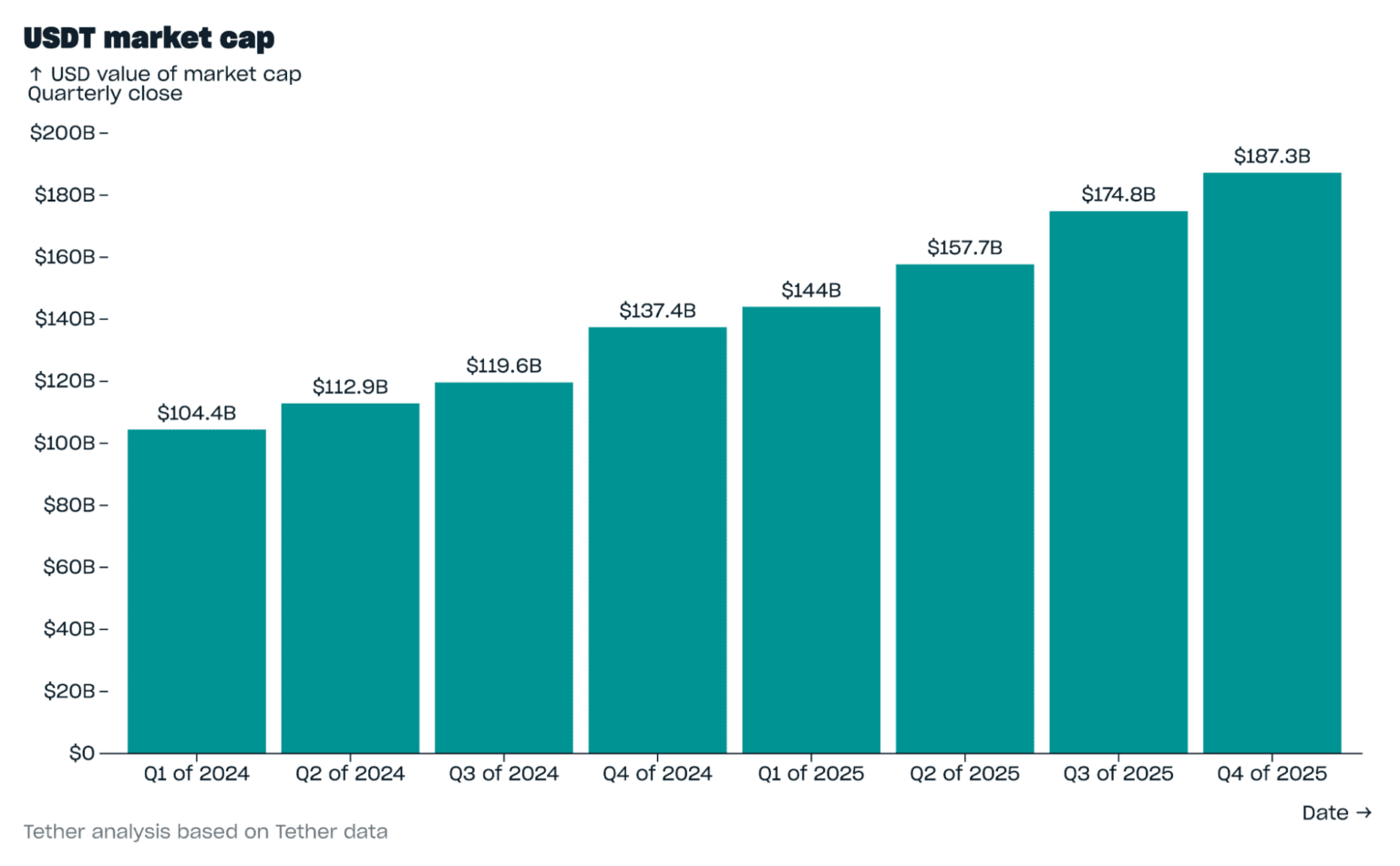
Tether is not a passive bystander. The company reported a net profit of approximately $13 billion in 2024, generated from the yield on its T-Bill holdings. By Q4 2025, Tether held $141.6 billion in U.S. Treasury securities, making it the 18th largest holder of U.S. Treasuries globally, ahead of Saudi Arabia and Germany. It added $28.2 billion in Treasuries across 2025 alone, the 7th largest buyer among any nation or entity worldwide.
Total reserves reached $192.9 billion against a net equity of $6.3 billion. Reserve assets include 96,184 BTC and 127.5 metric tons of gold, both growing significantly in Q4 2025.
Beyond finance, Tether has been deploying profits into AI infrastructure through its Tether EVO division, which placed 4th globally in a brain-computer interface AI benchmark in February 2026. Tether CEO Paolo Ardoino has publicly committed to engaging a Big Four firm for a full audit. If that audit is completed and clean, it would significantly reduce the primary transparency criticism against USDT and further cement Tether's position not just as a stablecoin issuer, but as one of the world's largest and most unusual financial entities.
USDC's Growth Trajectory
Circle's path is more straightforward, but not without challenges. The company's Q3 2025 revenue grew 66% year-over-year to $740 million, driven by USDC circulation growth. However, Circle's business model — earning yield on reserves while paying nothing to USDC holders — is sensitive to interest rate movements. A significant decline in U.S. Treasury yields would compress Circle's revenue meaningfully. The stock market has already priced in some of this risk: CRCL shares fell roughly 75% from their June 2025 peak to early 2026 lows.
New Entrants Reshaping the Field
PayPal's PYUSD, Ripple's RLUSD (launched 2024), and Societe Generale's euro stablecoin are all competing for share. Several large U.S. banks — emboldened by the GENIUS Act's explicit permissions for bank-subsidiary stablecoin issuers — have signaled plans to launch their own dollar stablecoins by 2026 or 2027. According to JAMS legal research published in December 2025, the GENIUS Act's passage has drawn renewed attention from established financial institutions, with several exploring participation in the stablecoin ecosystem under the new framework.
The combined effect will likely be a larger, more competitive, and more regulated stablecoin market — one where Tether's offshore structure and Circle's reserve yield model will both face new pressures.
Conclusion: Stop Treating USDT and USDC as Interchangeable
They are not the same dollar. They never were. And in 2026, the divergence is bigger and more legally consequential than at any prior point.
USDT gives you the deepest market liquidity and the widest global reach outside regulated EU platforms. USDC gives you the cleanest regulatory profile, the most transparent monthly reserve disclosures, and the strongest institutional backing — now verified by public market accountability via NYSE:CRCL.
The GENIUS Act has made the question more urgent, not less. If you are holding stablecoins on a U.S. or EU-regulated platform, or if your business touches either jurisdiction, a passive "keep what I have" approach is no longer risk-neutral.
If you are trading actively on global platforms where USDT has the liquidity you need, use USDT where it gives you the edge. If you are building, holding, operating in a regulated environment, or simply value reserve transparency over raw volume, move your base stablecoin position to USDC today.
Quick Win for Beginners
One Concrete First Step: Log into your exchange and check which stablecoin your current holdings use. If you are in the EU and still holding USDT, check whether your platform still supports it — many no longer do. If you are on a global platform and want to reduce regulatory uncertainty, convert a portion to USDC using a simple swap. Most exchanges execute this at zero or near-zero fees.
Resource Suggestion: Read Circle's latest monthly reserve attestation report at circle.com/usdc. It is updated monthly and takes five minutes to review. Compare it against Tether's quarterly attestation at tether.to/transparency — see for yourself what the transparency gap looks like in practice.
Engaging Question: If your stablecoin issuer had to meet full GENIUS Act audit requirements starting tomorrow, are you confident enough in their reserves to stay where you are?
⚠️ YMYL Disclaimer: This article is produced for educational and informational purposes only as of February 2026. It does not constitute financial, investment, legal, or tax advice. Cryptocurrency assets, including stablecoins, carry risk including the potential loss of principal. Reserve attestations are not the same as full independent audits. Regulatory landscapes are actively evolving — the GENIUS Act's implementing regulations had not been finalized at the time of publication. Market data including market capitalizations and stock prices changes daily. Before making any financial decision involving stablecoins or digital assets, consult a licensed financial advisor, tax professional, or legal counsel familiar with the laws applicable in your specific jurisdiction.